

AI-driven SOC: When the security team is no longer tied up by noise, but focused on real risks
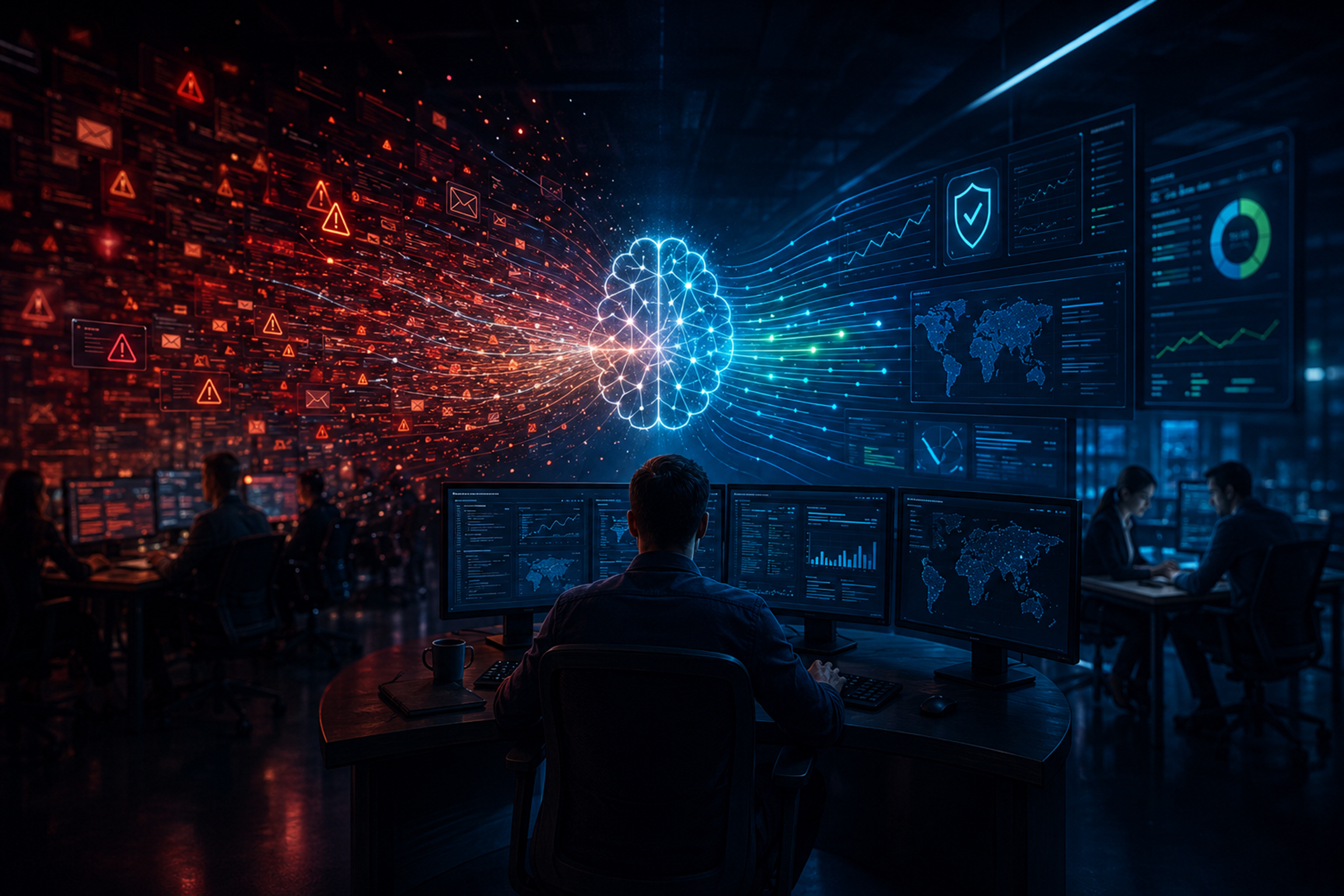
Most Security Operations Centers today are not overwhelmed because of attackers. They are overwhelmed because of their own operational model. An enterprise SOC can handle tens of thousands of alerts per day, a significant portion of which are false positives, low-priority events, or repetitive tasks that barely require human expertise. While security teams are dealing with staff shortages, growing compliance demands, and increasingly complex attack surfaces, many organizations still have senior specialists spending their time on mechanical analysis tasks.
This is the environment in which the concept of the AI-driven SOC has emerged, one that does not simply represent a new technology layer on top of existing security operations, but also a rethinking of the SOC's role. The question today is no longer whether artificial intelligence will appear in security operations, but to what extent it can take over operational tasks and how the role of humans will change alongside it.
Why has rethinking SOC operations become critical?
A large portion of traditional SOC models are built on human capacity. Analysts review alerts, correlate events, look for anomalies, and try to determine whether an event represents a real threat. This model worked for a long time, but the complexity of modern IT environments has significantly changed the situation.
Cloud-based infrastructures, hybrid work, SaaS systems, and an ever-growing number of endpoints generate volumes of data that can no longer be processed effectively by hand. At the same time, the speed of attacks has also increased. A well-automated attack chain can compromise systems within minutes, while on the defensive side, validating an incident often takes hours or days. This has created a paradox for many organizations. The security stack keeps getting more expensive and generating more data, yet the SOC responds more slowly because the team is overwhelmed by the information noise itself. Reducing this noise is one of the most important values of the AI-driven SOC.
Where does AI actually help in SOC operations today?
Artificial intelligence is currently strongest not in strategic decision-making, but in the rapid processing of large volumes of data and in recognizing patterns. This fits particularly well with SOC operations. One of the most important areas is alert pre-filtering. A modern AI model can prioritize events based on historical data, behavioral patterns, and environmental context. This is not simple rule-based filtering, but dynamic risk assessment. The system can recognize, for example, that unusual login activity for a given user is actually part of normal business operations, while the same pattern in another case represents high risk.
Log analysis is another equally important area. In an enterprise environment, millions of log events can be generated per minute. Finding hidden correlations among these manually is practically impossible. AI, however, is capable of recognizing correlations that would only be detectable by humans with significant time investment. An increasing number of organizations are also using AI for anomaly detection. Here, the goal is not to recognize known attack patterns, but to find deviations from normal operations. This is especially important for attacks that do not fit classic IOC or signature-based models.
Automated response actions are also developing rapidly. In certain incidents, AI no longer just recommends the necessary response. It can also execute isolation or containment actions through automated playbooks. Disconnecting a compromised endpoint or temporarily disabling a suspicious account can in many cases happen without human intervention.
AI does not replace the SOC team, it reshapes roles
In discussions around AI-driven SOCs, the question often arises whether human analysts will be needed at all in the future. In practice, however, the evidence points in the opposite direction. The greatest value in security operations lies not in repetitive operational tasks, but in context-based decisions. Assessing the business impact of an incident, weighing risks, or interpreting a complex attack chain still requires human expertise.
AI primarily takes over low-value-added tasks. Less time is spent on manual alert triage, reviewing logs, or repetitive analyses. This allows SOC teams to focus more on strategic matters, such as threat hunting, deeper analysis of attack patterns, or developing risk models. This shift is also critical from a business perspective. The shortage of security professionals is not expected to be resolved in the short term. For many organizations, AI is therefore not a convenience feature, but an operational necessity.
Why doesn't AI work well on its own?
Significant hype has developed around the AI-driven SOC, but many companies are making the same mistake here as they have with other security technologies before: treating the platform as the solution. In reality, AI performance is heavily dependent on the surrounding operational model. With poor-quality data, incomplete log sources, or disorganized processes, AI will generate just as much noise and false conclusions as human analysts. The governance question is particularly important. An automated response action suggested by AI can have serious business consequences. An incorrect account block, a faulty isolation, or a poorly prioritized incident can even cause business continuity issues. Therefore, control, auditability, and validation of AI operations are crucial.
Truly effective AI-driven SOCs are generally not born from technology projects, but from operational transformation. The foundation of success is a well-structured data model, clean incident management processes, proper SIEM and SOAR integrations, and a clear decision-making framework. Interestingly, these are exactly the factors whose absence prevents many traditional, fully human-operated SOCs from functioning effectively as well.
What does this mean for companies in practice?
In the coming years, two SOC models are expected to diverge in the market. On one side will remain those operations still built on manual analysis, with high operational loads and slower response times. Maintaining these will become increasingly expensive, while the overload on security teams continues to grow. On the other side, AI-supported SOCs will emerge where human expertise does not disappear. It moves to a higher level. Analysts are not dealing with masses of alerts, but making decisions, validating findings, interpreting correlations, and managing business risks.
This is not only a technological question, but an organizational one. Implementing an AI-driven SOC often goes hand in hand with rethinking the security operating model, restructuring areas of responsibility, and shifting competencies. For companies, therefore, one of the most important questions today is no longer whether to introduce AI into SOC operations, but at what level of maturity they are capable of integrating it truly effectively.
AI alone does not make a company more secure
The real value of artificial intelligence lies not in building a "smarter" SOC, but in enabling the security team to shift focus. Less operational noise, faster response times, and better scalability are achievable when AI fits into proper processes and control mechanisms. Companies that treat AI purely as an automation tool will likely quickly reach its limits. Those that view it as a strategic operational element, however, can gain a significant advantage in both security effectiveness and resource optimization. The future of the AI-driven SOC is therefore not about security operations without humans. It is about security professionals finally being able to focus on what truly requires expertise.
Other News and Events from ViVeTech

What Is Indirect Prompt Injection? How Attackers Hijack AI Agents Through Web Content and Emails
Learn more
További híreink és eseményeink
Mi az az indirekt prompt injection? Így térítik el az AI ágenseket a webes tartalmakon és e-maileken keresztül
Olvasson tovább
Hírlevél feliratkozás

Sign up for our newsletter